

The Dangerous Gap: When Courts Uphold Press Freedom in Theory but Fail Journalists in Reality

Farm Fires Decline Across Several States; Monitoring Gaps and Uneven Progress Remain
November 18, 2026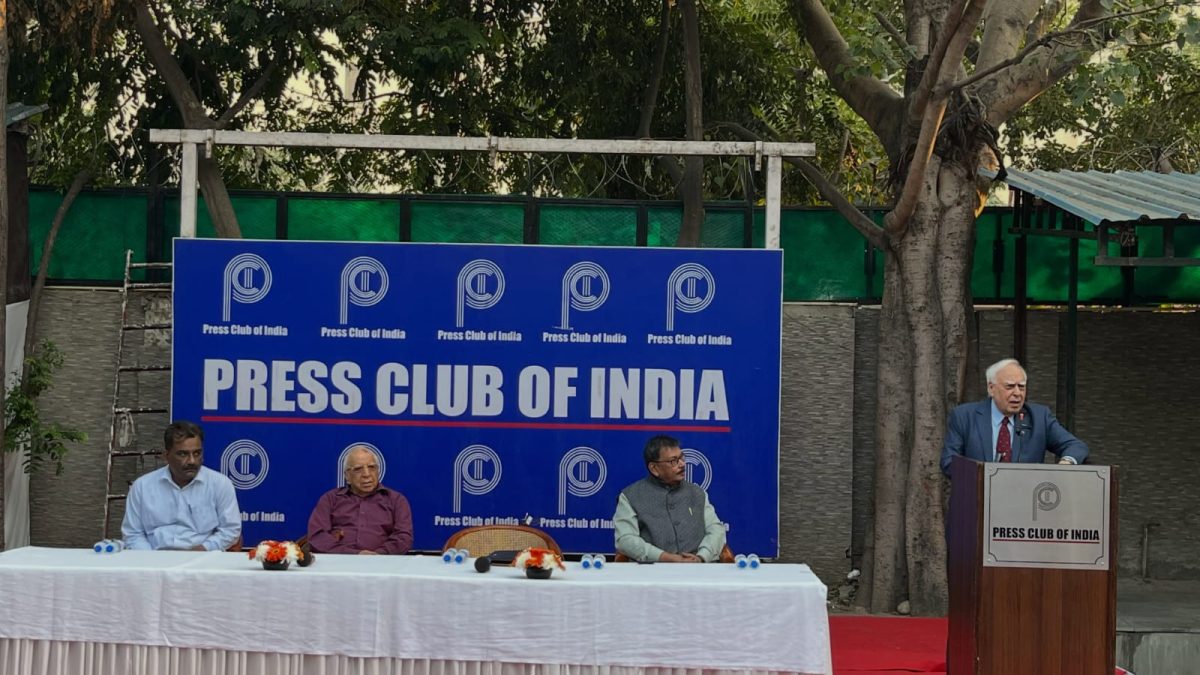
The concerns are also significant for agriculture and rural journalism, especially in the backdrop of the government’s handling of farmers’ protests, during which several journalists faced police action, FIRs and arrests for their reporting.
New Delhi, November 18, 2026 | Aranya Singh; In an ironic turn of events, the judiciary in India has failed to protect journalists, despite upholding the right to freedom of the press under the Indian Constitution for many years, said Rajya Sabha member and veteran lawyer Kapil Sibal at the Press Club of India (PCI) on Tuesday, on the occasion of Foundation Day of PCI.
Speaking on the topic, ‘Has the Judiciary Protected Press Freedom in the World’s Largest Democracy?’, Sibal said the judicial system too had not lived up to expectations. Delays in judicial intervention, prolonged trials and criminal proceedings against journalists, he argued, had increasingly become instruments of intimidation.
Sibal explained that although Article 19(1)(a) of the Constitution guarantees freedom of speech and expression, which the Supreme Court has interpreted to include freedom of the press, the reality remains different. “The Constitution has already answered the question. The practice has not. That is the gap we must examine today,” he said.
Referring to landmark judgments in Ramesh Thapar, Brij Bhushan and Sakal Papers, Sibal said the Supreme Court had consistently upheld press freedom by striking down pre-censorship and restrictions on newspaper circulation. A free press, he maintained, was essential to ensure citizens remained informed about government actions.
However, he warned that restrictions justified in the name of national security were increasingly being used to suppress criticism of the government. Reporting that questions administrative decisions or exposes governance failures was often portrayed as a threat to the State.
Sibal stressed that restrictions on press freedom must satisfy the conditions laid down under Article 19(2), with the government bearing the burden of justification. In practice, however, journalists were being punished through prolonged legal proceedings even before the merits of their cases were established.
Referring to the Supreme Court’s 2023 MediaOne judgment, he highlighted the court’s warning that labelling critical journalism as anti-establishment creates a chilling effect. “A press that is expected to support the government is not a press. It is a department,” he said.
He also cited the detention and obstruction of more than 40 journalists during October protests in Delhi against the Special Intensive Revision (SIR) of electoral rolls. According to Sibal, a subsequent special sitting of the Supreme Court directed that journalists, lawyers and other professionals should not be prevented from performing their duties.
Raising concerns over the Digital Personal Data Protection Act, he warned that the absence of an explicit exemption for journalistic activities could compromise investigative reporting, particularly where journalists are required to seek consent from individuals they are investigating or risk exposing confidential sources.
The concerns are also significant for agriculture and rural journalism, especially in the backdrop of the government’s handling of farmers’ protests, during which several journalists faced police action, FIRs and arrests for their reporting. The experience highlighted the vulnerability of reporters covering farmers’ movements and questioning government policies affecting rural communities.
In January 2021, freelance journalist Mandeep Punia was arrested by Delhi Police while reporting on the farmers’ protests at the Singhu border against the three farm laws. He was granted bail on February 2. Another journalist, Dharmender Singh, was also detained while covering the agitation. The Committee to Protect Journalists documented these cases, along with criminal complaints against several other journalists reporting on the protests.
The risks extend beyond farmers’ movements. In 2019, Uttar Pradesh journalist Pawan Jaiswal was booked for recording a video showing schoolchildren being served roti and salt under the mid-day meal scheme in Mirzapur. The Press Council of India took suo motu cognizance of the FIR, and police subsequently gave him a clean chit, finding no evidence against him.
Such incidents underline the challenges faced by agriculture reporters who go beyond official statements and policy announcements to investigate the implementation of government schemes, expose administrative failures and document farmers’ grievances.
Sibal maintained that despite landmark judicial pronouncements, inconsistent enforcement of constitutional protections had left independent journalism vulnerable to executive pressure, criminal prosecution and intimidation.
______________________________________________________________________________