

Farm Fires Decline Across Several States; Monitoring Gaps and Uneven Progress Remain

‘De-risking Is About Reducing Damage’: IDH’s Jagjeet Singh Kandal on Building Climate-Resilient Agriculture
November 6, 2026
The Dangerous Gap: When Courts Uphold Press Freedom in Theory but Fail Journalists in Reality
November 18, 2026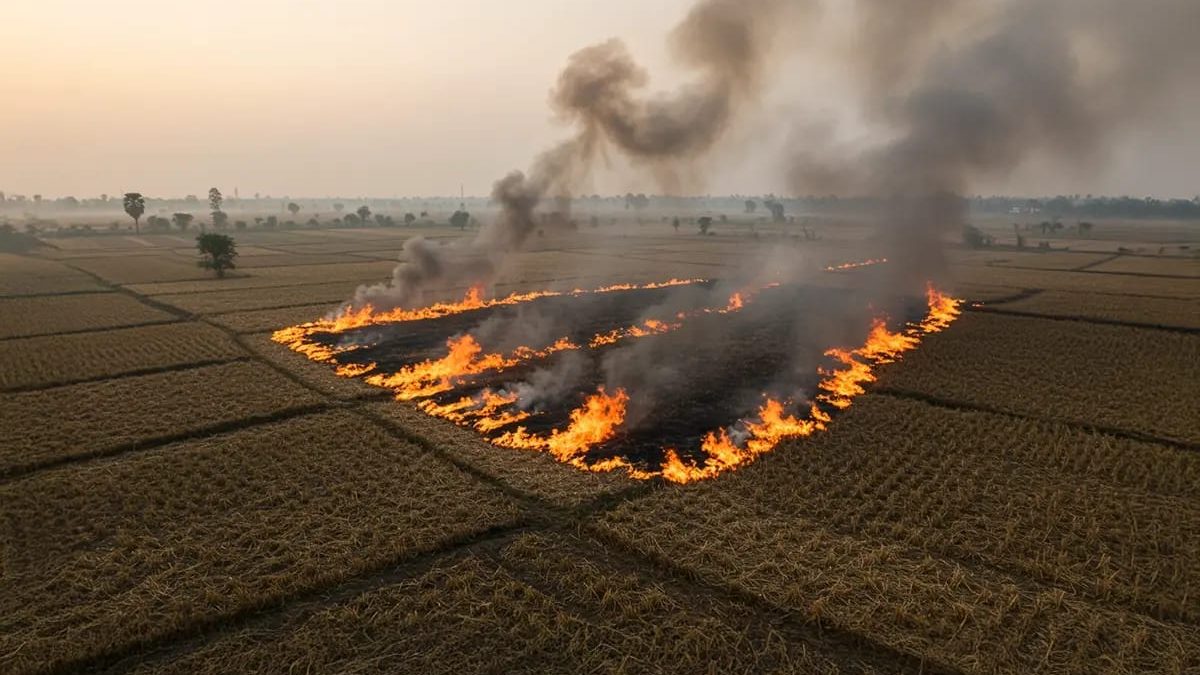
New Delhi, November 18, 2026 (ANN): Satellite data indicate a significant decline in stubble-burning incidents across several northern states during the 2026 paddy harvesting season, although the pace of improvement varies across regions. Uttar Pradesh and Haryana have recorded substantial reductions, while Punjab continues to account for the largest number of detected farm fires, highlighting the need for sustained monitoring and better access to crop-residue management alternatives.
According to the latest available data from the Indian Agricultural Research Institute (ICAR-IARI), satellites detected 11,342 crop-residue burning incidents across six states and Delhi between September 15 and November 13, 2026. Uttar Pradesh recorded 919 incidents, against 2,224 during the corresponding period last year, registering a decline of nearly 59 per cent.
Punjab reported 5,785 incidents, followed by Madhya Pradesh with 2,752, Rajasthan with 1,439, Haryana with 229 and Uttarakhand with 216.
The longer-term trend is particularly encouraging in Punjab and Haryana. According to ICAR-IARI data for September 15 to November 3, Punjab’s farm-fire incidents fell from 43,994 in 2020 to 2,196 in 2026, a reduction of approximately 95 per cent. Haryana recorded an even steeper decline, from 2,699 to 52 incidents, or nearly 98 per cent, during the same period.
However, the improvement has not been uniform. Punjab’s latest cumulative figure also underlines that farm fires remain a concern, while reviews by the Commission for Air Quality Management (CAQM) have emphasised the need for stronger verification of burnt fields and effective enforcement.
What is stubble burning and why does it happen?
Stubble burning is the practice of setting fire to leftover stalks, roots and other crop residues after harvesting. In northern India, it is particularly associated with paddy cultivation, where combine harvesters leave substantial quantities of straw in the fields.
The practice is closely linked to the short interval between paddy harvesting and wheat sowing. Farmers generally have around 15–20 days to clear their fields and prepare them for the next crop. Removing the residue manually or managing it through machinery requires additional labour, time and expenditure. Burning offers a quick and relatively inexpensive method of clearing fields.
The problem is compounded by the limited traditional market for paddy straw. Unlike wheat straw, it is less commonly used as cattle fodder because of its high silica content and lower palatability. Its transportation and storage are also expensive.
Consequently, farmers, particularly those operating small holdings, often find themselves constrained by the cost and availability of alternatives.
Stubble burning, however, has environmental consequences. It releases particulate matter, carbon monoxide and other pollutants into the atmosphere. It also destroys beneficial soil microorganisms, affects soil organic matter and releases greenhouse gases.
Why have farm fires declined?
The decline is generally attributed to a combination of government support, mechanization, monitoring and greater awareness among farmers. Equipment such as Happy Seeders, Super Seeders, mulchers and balers enables farmers to manage crop residue without burning it. Satellite-based monitoring, village-level surveillance and penalties have also increased scrutiny.
However, the availability of machinery does not necessarily guarantee its timely accessibility. Farmers frequently face shortages during the narrow period between paddy harvesting and wheat sowing. The cost of hiring equipment, transportation and the absence of assured buyers for straw remain important constraints.
Western Uttar Pradesh: Improvement, but local challenges remain
Western Uttar Pradesh has also recorded a decline in farm fires. ICAR-IARI data show that eight Uttar Pradesh districts falling under the NCR recorded 34 incidents between September 15 and November 13, compared with 77 during the corresponding period last year, a reduction of nearly 56 per cent.
Muzaffarnagar and Shamli reported no detected incidents, while Meerut recorded only one. However, Gautam Buddha Nagar and Hapur witnessed increases, indicating that progress remains uneven even within the region.
The paddy-wheat cropping system, fragmented landholdings and limited access to affordable machinery continue to complicate residue management in western UP. In several areas, farmers also lack adequate storage facilities and organised markets for paddy straw.
Chouhan says farmers should not be blamed for pollution
Amid the continuing debate over stubble burning and Delhi-NCR’s air pollution, Union Agriculture Minister Shivraj Singh Chouhan has urged people not to single out or defame farmers.
During his November 17 visit to Samrala in Punjab’s Ludhiana district, Chouhan congratulated Punjab’s farmers for the reduction in farm fires and said they had demonstrated that paddy straw could be managed without burning.
“Farmers should not be defamed, and people should not blame them for pollution. There are several other factors responsible for pollution,” he said.
He also highlighted the role of crop residue in improving soil health, saying that incorporating stubble into fields increases organic carbon. He called for making residue-management machinery more affordable and accessible to farmers.
______________________________________________________________________________